


Page 3 - reflections_newsletter10
P. 3
REFLECTIONS
                                                                                                                   Dyslipidaemia
     Dyslipidaemia Global Newsletter #10 2025


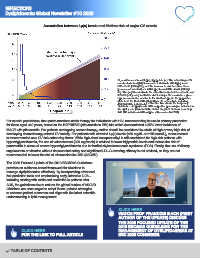
                            Association between Lp(a) levels and lifetime risk of major CV events                  Dyslipidaemia


                                                                         CI, confidence interval; Lp(a), lipoprotein (a). The risk of major CV
                                                                         events starts to slightly increase in individuals with Lp(a) levels
                                                                         >62 nmol/L (30 mg/dL), and the increase in risk becomes more
                                                                         pronounced in individuals with Lp(a) levels ≥105 nmol/L (50 mg/
                                                                         dL). The grey lines indicate the smoothed adjusted hazard ratio and
                                                                         95% CI (left y-axis) for lifetime risk for major CV events for a given
                                                                         Lp(a) concentration relative to the median Lp(a) in the population
                                                                         (data from the United Kingdom Biobank, subanalysis including
                                                                         415,274 white individuals).  The blue line shows the frequency
                                                                                           a
                                                                         distribution of Lp(a) levels, with respective percentages indicated in
                                                                         the right y-axis (data from the United Kingdom Biobank, including
                                                                         443,180 individuals without prior atherosclerotic CVD).

     For special populations, the update mentions statin therapy for individuals with HIV, recommending its use in primary prevention
     for those aged ≥40 years, based on the REPRIEVE (pitavastatin in HIV) trial which demonstrated a 35% lower incidence of
     MACE with pitavastatin. For patients undergoing cancer therapy, statins should be considered in adults at high or very high risk of
     developing chemotherapy-related CV toxicity. For patients with elevated Lp(a) levels (>50 mg/dL or >105 nmol/L), measurement
     is recommended as a CV risk-enhancing factor. While high-dose icosapent ethyl is still considered for high-risk patients with
     hypertriglyceridaemia, the use of volanesorsen (300 mg/week) is advised to lower triglyceride levels and reduce the risk of
     pancreatitis in cases of severe hypertriglyceridaemia due to familial chylomicronaemia syndrome (FCS). Finally, the use of dietary
     supplements or vitamins without documented safety and significant LDL-C-lowering efficacy is not advised, as they are not
     recommended to lower the risk of atherosclerotic CVD (ASCVD).


     The 2025 Focused Update of the 2019 ESC/EAS Guidelines
     provides an evidence-based framework for clinicians to
     manage dyslipidaemias effectively. By incorporating advanced
     risk prediction tools and emphasising early, intensive LLTs –
     including starting with statin and ezetimibe in patients after
     ACS, the guidelines aim to reduce the global burden of ASCVD.
     Clinicians are encouraged to adopt these updated strategies
     to enhance patient outcomes and align with the latest scientific
     understanding in lipid management.


                                                                         CLICK HERE
                                                                         WATCH PROF. FRANCOIS MACH (FIRST
                                                                         AUTHOR OF THE UPDATE) DISCUSS
                                                                         THE 2025 FOCUSED UPDATE OF THE
                                                                         2019 ESC/EAS GUIDELINES FOR THE
              CLICK HERE                                                 MANAGEMENT OF DYSLIPIDAEMIAS AT
              FOR THE LINK TO FULL ARTICLE                               ESC 2025 CONGRESS.


          TABLE OF CONTENTS

