


Page 8 - reflections_newsletter10
P. 8
REFLECTIONS
                                                                                                                   Dyslipidaemia
     Dyslipidaemia Global Newsletter #10 2025


     support tools, patient education, and incentives for large-scale
     production, along with a “rebranding” effort to build public and                                              Dyslipidaemia
     institutional trust, similar to how fixed-dose combinations were
     successfully adopted in HIV/AIDS programs.


                                                                         CLICK HERE
                                                                         LISTEN TO JACC’S EDITOR-IN-CHIEF
              CLICK HERE                                                 DR. HARLAN KRUMHOLZ SUMMARISE
              FOR THE LINK TO FULL ARTICLE                               THIS STUDY (1:12-2:33).


     The evolving landscape of targets for lipid lowering: From molecular mechanisms
     to translational implications.

     Ballantyne CM, et al. Eur Heart J. 2025 Sep 5;ehaf606. doi: https://doi.org/10.1093/eurheartj/ehaf606. Online ahead of print.

     Dyslipidaemia remains a major contributor to CVD, and while lowering LDL-C is the primary target for prevention, significant residual
     risk persists. This risk is driven by other factors, including TGs, apoB, and Lp(a). Furthermore, apoB, which reflects the number of
     atherogenic particles, is considered a superior predictor of CVD risk compared to LDL-C or TG levels alone. This review looks to
     discuss current and novel LLTs from a pharmacological and clinical perspective, focusing on the mechanism of action and expected
     benefits in patients with CVD.
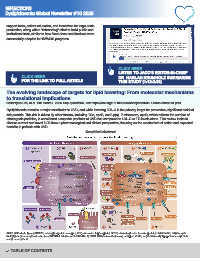
                                                     Graphical abstract


     ACLY, ATP citrate lyase; ASGPR, asialoglycoprotein receptor; ATP, adenosine triphosphate; CETP, cholesteryl ester transfer protein; HMG-CoAR, 3-hydroxy-3-
     methylglutaryl coenzyme A reductase; NPC1L1, Niemann-Pick C1-like 1; RISC, RNA-induced silencing complex; VLDL, very-low-density lipoprotein; acetyl-CoA,
     acetyl coenzyme A.


          TABLE OF CONTENTS

