


Page 14 - reflections_newsletter10
P. 14
REFLECTIONS
                                                                                                                   Dyslipidaemia
     Dyslipidaemia Global Newsletter #10 2025


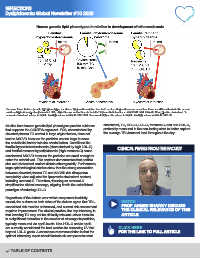
                       Human genetic lipid phenotypes in relation to development of atherosclerosis                Dyslipidaemia


     Because these human genetic lipid phenotypes are driven by genetic variation free from confounding and reverse causation, these conditions illustrate the causal
     relationship from respectively elevated LDL, chylomicrons, and remnants to risk of myocardial infarction and ASCVD. mM, mmol/L; Chol, plasma cholesterol. To
     convert cholesterol values to mg/dL, multiply values in mmol/L with 38.6. To convert triglyceride values to mg/dL, multiply values in mmol/L with 88.


     Studies from human genetic lipid phenotypes provide evidence   cholesterol, TG, HDL-C, LDL-C, remnant-C, and non-HDL-C,
     that supports the CONTRA argument. FCS, characterised by   preferably measured in the non-fasting state to better capture
     elevated plasma TG carried in large chylomicrons, does not   the average TRL/remnant load throughout the day.
     lead to ASCVD because the particles are too large to cross
     the endothelial barrier into the arterial intima. Conditions like
     familial hypercholesterolaemia (characterised by high LDL-C)       CLINICAL PEARLS FROM THE FACULTY
     and familial remnant hyperlipidaemia (high remnant-C) cause
     accelerated ASCVD because the particles are small enough to
     enter the arterial wall. This contrast demonstrates that particle
     size and cholesterol content dictate atherogenicity. Furthermore,
     large epidemiological studies show that the strong association
     between elevated plasma TG and ASCVD risk disappears
     completely when adjusted for lipoprotein cholesterol content,
     including remnant-C. Therefore, focusing on remnant-C
     simplifies the clinical message, aligning it with the established
     paradigm of reducing LDL-C.

     Regardless of the debate over which component is strictly
     causal, the authors on both sides of the debate agree that TRL-       WATCH
     associated risk must be addressed, and current risk assessment        PROF. AHMED SHAWKY DISCUSS
     requires improvement. For clinical practice, the key takeaway is      THE CLINICAL RELEVANCE OF THIS
     that lowering TG may not be clinically relevant unless it results     ARTICLE.
     in a significant reduction in the number of atherogenic particles,
     typically measured via apoB levels. Non-HDL-C and/or apoB
     are currently considered the best metrics for assessing CV risk     CLICK HERE
     beyond LDL-C goals. A consensus recommendation is that the          FOR THE LINK TO FULL ARTICLE
     optimal laboratory report should include six components: total


          TABLE OF CONTENTS

