


Page 11 - reflections_newsletter10
P. 11
REFLECTIONS
                                                                                                                   Dyslipidaemia
     Dyslipidaemia Global Newsletter #10 2025


     Gene editing approaches, such as CRISPR-Cas9, base editing, and reverse transcriptase editing, enable direct modification or
     inactivation of cholesterol-raising genes. In contrast, gene addition therapies, often delivered via adeno-associated viral (AAV)
     vectors, insert functional copies of defective genes. Key molecular targets include PCSK9, ANGPTL3, APOC3, and LPA, which
                                                                                                                   Dyslipidaemia
     play central roles in LDL-C, TG, and Lp(a) metabolism.

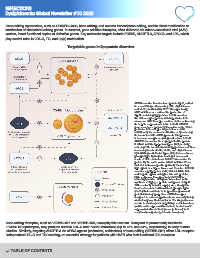
                                          Targetable genes in lipoprotein disorders


                                                                                   APOB encodes the structural protein ApoB, critical
                                                                                   for assembling and secreting LDL, chylomicrons
                                                                                   and VLDL, facilitated by MTP. Therapeutically,
                                                                                   MTP inhibitors can reduce the production of
                                                                                   ApoB-containing lipoproteins. LDLR encodes
                                                                                   the LDL receptor protein, which promotes LDL
                                                                                   clearance, with therapies such as statins enhancing
                                                                                   its hepatic expression to lower LDL-C. PCSK9
                                                                                   gene encodes a protein by the same name, which
                                                                                   promotes LDL receptor degradation, and its
                                                                                   inhibition by monoclonal antibodies or by reducing
                                                                                   its translation with siRNA prevents this process,
                                                                                   to increase receptor recycling and reduce LDL-C.
                                                                                   ANGPTL3 encodes the angiopoietin-like protein
                                                                                   3, which inhibits lipoprotein lipase (LPL) activity,
                                                                                   reducing TGs breakdown from lipoproteins and thus
                                                                                   increasing levels of LDL, VLDL, and chylomicrons.
                                                                                   By inhibiting endothelial lipase (EL) it also reduces
                                                                                   phospholipids hydrolysis, leading to increased
                                                                                   levels of HDL cholesterol. ANGPTL4 encodes the
                                                                                   protein by the same name, which inhibits LPL as
                                                                                   well, but is tissue-specific, primarily modulating
                                                                                   lipid uptake in adipose tissue and muscles. APOC3
                                                                                   encodes apolipoprotein C-III, which inhibits LPL
                                                                                   and hepatic uptake of triglyceride-rich particles,
                                                                                   while antisense therapies target APOC3 to
                                                                                   lower triglycerides. LPA gene is involved in the
                                                                                   synthesis of Lp(a), a particle composed of ApoB-
                                                                                   100 covalently linked to apo(a) via a disulphide
                                                                                   bond and enriched with oxidised phospholipids
                                                                                   (OxPL) that contribute to its proatherogenic and
                                                                                   proinflammatory properties. siRNA therapies
                                                                                   designed to reduce Lp(a) levels are currently being
                                                                                   studied in phase 3 clinical trials. The diagram uses
                                                                                   arrows to show regulatory pathways and interactions
                                                                                   (solid arrows represent direct effect, dashed arrow
                                                                                   represents indirect effect) genes (in boxes) from
                                                                                   enzymes/transporter proteins (in hexagons).


     Base-editing therapies, such as VERVE-101 and VERVE-102, exemplify this new era. Designed to permanently inactivate
     PCSK9 in hepatocytes, they produce durable LDL-C and PCSK9 reductions (up to 73% and 84%, respectively) in early human
     studies. Similarly, targeting ANGPTL3 via siRNA agents (zodasiran, solbinsiran) or base editing (VERVE-201) offers LDL receptor-
     independent LDL-C and TG lowering, an essential strategy for patients with HoFH who lack functional LDL receptors.


          TABLE OF CONTENTS

