


Page 13 - reflections_newsletter10
P. 13
REFLECTIONS
                                                                                                                   Dyslipidaemia
     Dyslipidaemia Global Newsletter #10 2025


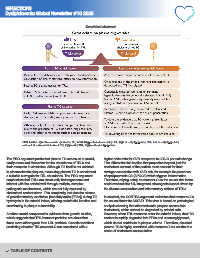
                                                     Graphical abstract                                            Dyslipidaemia


               FCS, familial chylomicronaemia syndrome; FH, familial hypercholesterolaemia; HDL, high-density lipoprotein; LDL, low-density lipoprotein;
               remnant-C, remnant cholesterol; TG, triglyceride; TRL, triglyceride-rich lipoprotein.


     The PRO argument posits that plasma TG serves as a crucial,   higher odds ratio for CVD compared to LDL-C per unit change.
     easily measured biomarker for the abundance of TRLs and    This differential risk implies that properties beyond just the
     their remnants in circulation. Although TG itself is not retained   cholesterol content of the particle must account for their
     in atherosclerotic plaques, measuring plasma TG is considered   stronger association with CVD risk, for example the presence
     a suitable surrogate for TRL abundance. The PRO argument   of apolipoprotein C3 (APOC3) which triggers inflammation.
     emphasises that TRLs are structurally heterogeneous and    Therefore, relying solely on remnant-C as the causal risk factor
     interact with the arterial wall through multiple, complex   could overlook the full, integrated atherogenic impact driven by
     pathogenic mechanisms, which are not fully captured by     the diverse composition and inflammatory actions of TRLs.
     cholesterol content alone. This complexity includes the release
     of proinflammatory mediators (free fatty acids [FFAs]) during TG   In contrast, the CONTRA argument maintains that remnant-C is
     hydrolysis in the arterial intima, altering endothelial function and   the causal factor for ASCVD. This view is based on pathological
     contributing to plaque vulnerability.                      analysis showing that atherosclerotic plaques accumulate
                                                                cholesterol, which cannot be degraded by arterial cells.
     Another crucial component is evidence from genetic studies,   However, when TRL remnants enter the arterial intima, their TG
     which suggests that TRL/remnant particles are about four   content is rapidly degraded into FFAs and monoacylglycerol,
     times more atherogenic than LDL particles. Genetic variations   which do not contribute to plaque volume. Therefore, elevated
     predicting elevated TRL/remnant-C are associated with a    plasma TG is highly correlated with remnant-C but not the true
                                                                cause of cholesterol accumulation.


          TABLE OF CONTENTS

